When it comes to upgrading concrete floors, home and business owners across the Sunshine Coast are faced with a fundamental decision: Do I choose traditional Epoxy or next-generation Polyaspartic coatings? Both are high-performance resin solutions, but their molecular makeup, curing times, UV stability, and price points vary significantly. Making the wrong choice can lead to a yellowing, peeling floor under the intense Queensland sun. In this ultimate comparative guide, we will break down the chemistry, performance metrics, and cost considerations to help you select the ideal coating system for your home or business.
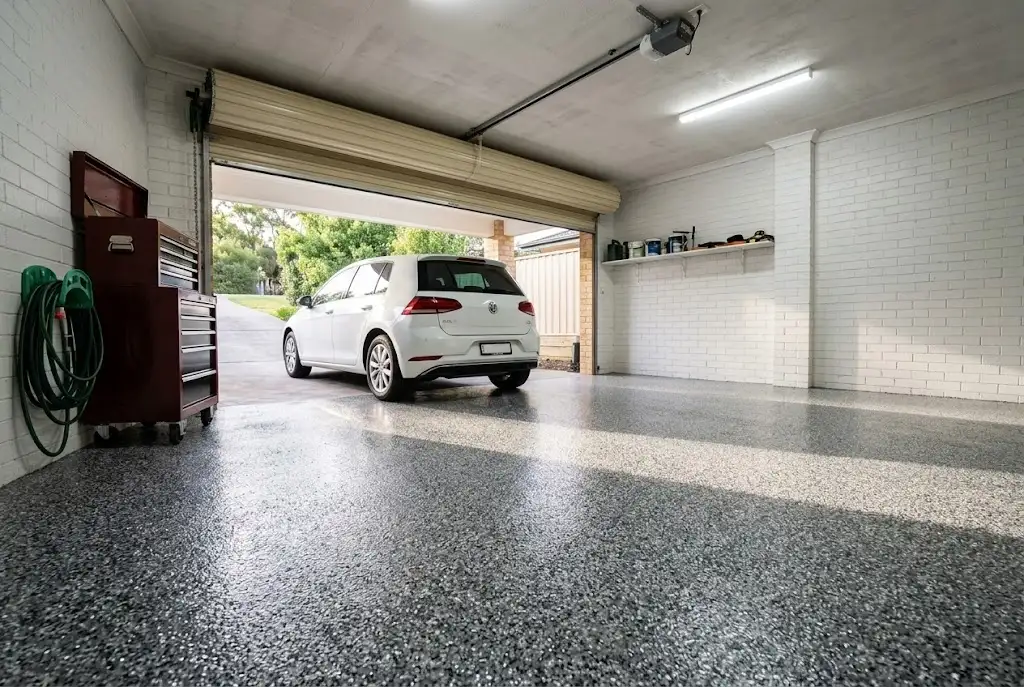
What Is Epoxy Flooring?
Traditional epoxy consists of a cross-linking polymer created by mixing two parts: an organic resin base and an amine-based hardener. When coupled together, they undergo a thermosetting chemical reaction that transforms a liquid into a hard, rigid plastic matrix that tightly bonds to appropriately prepared concrete pores.
EPoxy has been the global industrial standard for floor protection for nearly half a century. Because it cures at a deliberate, slow pace, it excels at self-leveling, filling minor concrete imperfections, and deeply absorbing into concrete capillaries. This creates an exceptionally tough structural foundation. It is highly resistant to heavy machinery drops, industrial oil leaks, and abrasive wear, making it an excellent choice for indoor residential garage bays, commercial warehouses, and heavy manufacturing facilities.
What Is Polyaspartic Flooring?
Polyaspartic technology is a relatively modern offshoot of polyurethane chemistry. It was originally engineered in the late 1980s specifically as an anti-corrosion barrier coating for heavy industrial bridges, steel hulls, and outdoor railcars.
Technically, polyaspartics are aliphatic polyureas. The key innovation is an ester compound added to the hardener component that delays the chemical reaction. This allows installers to brush, roll, and squeegee the coating onto concrete manually before it hardens. Polyaspartic coatings are incredibly dense, setting with exceptional tensile strength and flexibility. They are highly flexible and elastic, allowing the surface to yield slightly under thermal expansion and contraction without cracking.
Key Differences: Epoxy vs Polyaspartic
Understanding the major differences between these two elite polymers makes it much easier to decide which fits your specific floor plan:
| Feature | Epoxy Flooring | Polyaspartic Flooring |
|---|---|---|
| Cure Time | 24–72 hours (minimum 3 days for cars) | 1–2 hours (fully cure in 24 hours) |
| UV Resistance | Poor (prone to ambering/yellowing in direct sun) | Excellent (completely UV-stable) |
| Abrasion Resistance | Good (industry-grade standard durability) | Outstanding (up to 4x harder than epoxy) |
| Cost | Moderately affordable & cost-effective | Higher upfront material investment |
| Best For | Budget-conscious residential & warehouse floors | Sun-exposed patios, garages & fast-handover shops |
- The Timeline factor (Curing Speed): Traditional epoxy takes up to 72 hours to fully cure, meaning you have to park on the street for several days. Polyaspartic systems can cure within a single day. At Best Coat Epoxy, we frequently execute complete "one-day floor makeovers" using rapid-set polyaspartics.
- Elasticity & Impact: Polyaspartic is vastly more flexible than epoxy. If a heavy tool drops on a rigid epoxy surface, there's a risk of micro-chipping. An elastomeric polyaspartic coating absorbs the shock, resulting in outstanding protection.
Which Is Better for Queensland's Climate?
In Southeast Queensland and along the Sunshine Coast, we experience intense heat, high humidity, and extreme UV rays. This atmospheric mix is notoriously harsh on resin systems. Indeed, UV radiation causes standard aromatic epoxies to chemically degrade over time—a process called photodegradation. If you install standard epoxy on a sun-drenched pool deck, an open driveway, or even in a garage getting afternoon sun, it will fade to a yellowish brown and lose its glossy finish.
Polyaspartic polymers are inherently aliphatic, meaning they feature strong, carbon-derived chemical links that completely resist ultraviolet energy. Choosing polyaspartic for any exposed exterior surface ensures that your patio, balcony, or carport retains its brilliant colors and shiny finish for 15+ years without showing any signs of sun damage.
Cost Comparison on the Sunshine Coast
Given the superior stats of polyaspartic, it’s natural to expect a higher price tag. On average, a professional polyaspartic flooring installation on the Sunshine Coast ranges from $90 to $130 per square meter, depending on preparation requirements. Traditional epoxy systems are more budget-friendly, starting between $75 and $95 per square meter.
However, when looking closely at the total value proposition, polyaspartics often prove more cost-effective. The fast cure speed drastically minimizes down-time for local commercial businesses, which can open to customers sooner and avoid costly closures. For residential clients, saving the cost of renting transport storage or leaving cars on public roads for many days offset the upfront premium.
The Best Coat Epoxy Approach: Why We Use Both
At Best Coat Epoxy, we don’t believe in a one-size-fits-all approach. Rather than forcing you to settle for one or the other, we combine these two premium resins to design the ultimate hybrid flooring system.
For our classic garage installations, we utilize an Epoxy Base Coat paired with a Polyaspartic Top Seal. The epoxy layer delivers deep substrate absorption, maximum adhesion, and an incredibly thick foundation. We broadcast our decorative flakes over this solid base, and seal it with an aliphatic polyaspartic topcoat. This hybrid construction ensures outstanding adhesion, while keeping your floor perfectly UV-stable and highly resistant to chemical spills and daily tyre friction.
Get a Free Quote Today
Are you ready to transform your concrete slab into a pristine, high-performance asset? Our owner-operated team stands for flawless diamond-grinding preparation, verified E2U chemicals, and spotless cleanups. We’ll visit your location, take diagnostic moisture readings, present our flake catalog, and design a customized hybrid system suited for your budget.
Frequently Asked Questions — Epoxy vs Polyaspartic
Q1. Is epoxy or polyaspartic better for a garage floor?
A hybrid system is generally best. We recommend an epoxy base coat for maximum adhesion to the concrete substrate, followed by an aliphatic polyaspartic topcoat to provide full UV stability and 4x greater abrasion resistance against tyre wear.
Q2. Will epoxy turn yellow under sunlight?
Yes, traditional epoxy undergoes photodegradation when exposed to UV light, which causes the material to yellow and fade over time. Aliphatic polyaspartic coatings are completely UV-stable and will not discolor.
Q3. How long does a polyaspartic coating take to cure compared to epoxy?
Polyaspartic cures extremely fast—often ready for foot traffic in 4-6 hours and vehicle traffic in 24 hours. Traditional epoxy typically requires up to 3 to 7 days before you can park vehicles on it.
Q4. Is polyaspartic more chemical resistant than epoxy?
Yes, polyaspartic offers superior chemical resistance to acids, heavy solvents, hot tyre pick-up, and oil spills compared to standard epoxy, making it ideal for mechanics, warehouses, and busy garages.
Q5. Why is polyaspartic flooring more expensive than epoxy?
The raw chemical formulations are premium and cure much faster, requiring experienced professionals to apply. However, the lifespan is nearly double, and it saves you days of downtime, making it more cost-effective overall.
Compare Materials On-Site With Cody
Arrange a completely free, obligation-free site survey at your home or business. We'll bring physical flake boards, measure your square metres, and quote you directly.